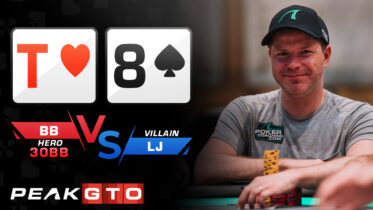
Put your opponent on one exact hand and you will be wrong most of the time. That is not a knock on your reads, it is just arithmetic, because there are simply too many hands they can hold.
The players who win consistently think a level higher. They compare their entire range against their opponent’s entire range, then figure out how the board treats both. And just as importantly, they know when to put that framework away, because half your opponents are not thinking about ranges at all.
This article walks through the levels of poker thinking, what range vs range analysis actually looks like, and real hand examples in Texas Hold’em that show the framework working and what happens when it gets misapplied.

The Five Levels of Poker Thinking
Every opponent you face sits somewhere on a ladder, and identifying that tells you how to beat them.
At the bottom are true beginners who barely know the rules, the players who reach the river and ask whether they won. Above them sit the amateurs, who look at their own two cards and nothing else. If the hand looks good, they play it.
Then come the decent players, who try to put you on a specific hand, which sounds sophisticated and mostly produces wrong answers.
The strong players are the ones thinking in ranges, assigning you a whole collection of possible hands and narrowing it street by street.
Excellent players go one step further. They think about your range, their own range, and how the board interacts with both at once. That last step is range vs range thinking, and it is where the real money lives.
What Range vs Range Thinking Looks Like
Here is the framework in action. An early position player raises, the big blind calls, and the flop comes nine-eight-seven.
A card-focused player asks whether they hit. A range-focused player asks something better. Whose range owns this board? The early position raiser’s tight range is full of big cards and overpairs. The big blind’s wide calling range contains all the sets, straights, and two pairs that a middling connected board creates.
That is why you see excellent players check-raising boards like nine-eight-seven and ten-seven-six relentlessly from the big blind, sometimes with nearly their whole range.
They are not claiming to have a monster this time. They are leveraging the fact that their range holds the monsters while the raiser’s range holds one pair at best, and the raiser knows it. Once you can see both ranges at once, plays that looked wild start looking mandatory.
Example One. Assigning the Wrong Range Preflop
Range thinking fails when you feed it the wrong inputs, and I have a funny story to prove it. Last Christmas, in a low-stakes home game, three players limped in front of me, and I looked down at king-jack offsuit with 15 big blinds.
I jammed, applying the standard rule that limpers are weak but a tight player who had barely played a hand all night snapped me off with ace-king.
The rule wasn’t wrong, but my range assignment was. These were beginning players who never raise anything, so their limps contained their entire range, including premium hands. A tight player who limps everything has a limping range full of monsters, and king-jack fares miserably against it.
The lesson applies everywhere. Ranges are built from how this specific player behaves, not from the template that fits players in general. Before you assign the standard range, ask whether your opponent even follows the standard.
Example Two. Your Hand Against Their Whole Range
Now the reverse situation, facing a player with no coherent range at all. This one comes from another tiny home game full of players seeing a flop for maybe the tenth time in their lives.
A beginner limps for 200, the button min-raises to 400, and the flop comes ace-four-four. A straightforward player who only bets when she has something leads out for 800, gets a call, and then a third beginner rips it all in with jack-ten high, a play that makes sense in no world. Facing that shove with ace-nine, what do you do?
You call, and the reasoning matters. Against a player whose actions have no logic, you cannot narrow their holdings, so you compare your hand to their whole chaotic range instead. Sometimes they show up with jack-four and stack you.
But ace-nine on ace-four-four beats the average of the nonsense, and better-than-average poker hands against random ranges win money over time. Do not let the occasional bizarre monster scare you off calls the math clearly supports.
Example Three. Scary Rivers Are Only Scary to Range Thinkers
The most profitable application of range thinking might be knowing when your opponent is not doing any.
This hand comes from a 500 euro event in Europe, against a player who was so clearly new that you could read it from how he stacked his chips. He limped, I raised ace-queen suited for value, and the flop came queen-nine-five.
He check-called a bet on the larger side, because players like this never notice sizing, then check-called 2,600 on a blank turn, a bet chosen specifically to leave him about 5,000 behind, half the pot, going to the river. The river was the king of clubs.
To a trained eye, that king is an ugly river, hitting jack-ten and king-queen. Against a good player, checking back is right, because their calling range on that card crushes a marginal top pair.
Against this player, bet. His actual calling range is any queen, any nine, and stubborn pocket pairs, and he has no idea the king should frighten him. Count the danger hands honestly and they barely exist, since limped king-queen combos are scarce and every suited backdoor draw is outnumbered three to one by its offsuit combinations.
Your own ace helps too, working as one of the blockers that makes the ace-king that got there even less likely.
The sizing is the final touch. Instead of jamming him all in for the last 5,000, bet around 3,500. Beginners dread losing their whole stack, and a bet that leaves them a few chips to fight with gets called far more often than the shove. In a 5,000 euro tournament, finding that extra bet instead of checking is worth real money every time the spot comes up, and most of the field never bets this river at all.
Match the Framework to the Player
Pull the examples together and a single principle emerges. Range vs range thinking governs how you play good players, and knowing your opponent ignores ranges governs how you play everyone else.
Against range-blind players, balance is wasted effort. Bet big with your value hands and small with your bluffs, because nobody is auditing your sizes.
Value bet rivers that look scary, call jams that make no sense, and stop expecting their lines to tell coherent stories. Online, the tells are in the stats, and a player entering half their hands while raising almost none is announcing they never left level one.
Against strong players, the framework comes back out. Ask whose range the board favors on every street, attack the boards that smash your range, and slow down on the ones that smash theirs. The skill is not choosing one mode. It is reading where your opponent stands on and meeting them there.
Practice the core question until it is automatic. Whose range does this board favor, and by how much?