
Picking the right poker coach is one of the highest-leverage decisions you can make in your poker development. Done well, coaching accelerates your results in a way that years of solo study cannot match.
Done poorly, it wastes money and can even introduce bad habits into your game. I have been coaching poker players for years at every level, and the patterns of what works and what does not work in poker strategy are consistent enough to give you a clear framework for making this decision.
This article covers the types of coaching available, what to look for when evaluating a coach, and how to get full value from every session you pay for.
Getting Started with Poker Coaching
The online poker community looks a lot different today than it did back in the day, and there are way more resources you can find for free than you could in 2005.
Today, many poker coaching sites offer some or even all of their content for free. You can even grab free 3-day access to our entire premium here.
If you are just starting in poker, you don’t necessarily need to pay someone to teach you advanced concepts or go through hand simulations to solve very particular spots.
Instead, you need to learn the broad strokes, basic math, and elementary strategy that will allow you to understand any poker coaching you might get in the future.
Without understanding these basic poker concepts, you will never be able to go to the next level and master the game at the level you want to get to.
So, before you let someone talk you into paying for poker coaching, make sure you spend enough time learning from all the free poker coaching that’s available out there. Soak in the readily available knowledge and only look for the next steps when you feel like you aren’t learning anymore from the free stuff out there.
Learn Poker with Friends
Poker friends are underrated as a learning resource, and I tell students this all the time. When you study in isolation, your blind spots stay blind. Having someone else look at your plays who is not emotionally invested in the outcome will surface leaks that self-study misses.
Even if your poker friend is at roughly the same skill level as you are, the act of explaining your reasoning out loud is valuable in itself. It forces you to articulate why you made a play rather than just feeling your way through it.
While it is entirely possible to learn poker without collaborating with other players, doing so will allow you to learn faster and spot your mistakes with more ease.

If you are willing to share with your poker-playing friends and listen to constructive criticism, your poker-studying sessions could become a whole lot more productive.
The truth is that we all have blind spots for our own mistakes, and having someone point them out without prejudice is often what it takes to nudge you in the right direction.
Also, working with your poker friends to learn new poker games makes expanding your skills a lot more fun and exciting the next time you play.
There are plenty of poker communities on the internet these days where you can meet like-minded players and share your poker experiences to mutual benefit, so I highly recommend you take a look at these and make some poker friends you can grow with.
Buying the Right Poker Coaching Course
This is where most players go wrong. They see a well-produced course from a recognizable name and assume it will solve their problems. But the right course is not the most popular one or the most expensive one. It is the one that addresses the exact leaks in your game at the exact level you are currently playing.
I have seen players buy high-stakes tournament courses when they are still losing at low-stakes cash games. The concepts do not transfer. Match the course to where you are, not where you want to be eventually.
If you have already been playing poker for years or have spent hundreds of hours going over all the free poker coaching material out there, it may be time to get into the more advanced stuff.
Elite poker coaching programs are available at a price but are usually produced by some of the very best poker players in the world, making them well worth the price. PokerCoaching.com has a wide range of courses built by coaches with documented winning records across cash games and tournaments, so it is worth exploring if you are ready for structured coaching.
Yet, you are only going to get that value if you are ready to learn what’s being taught and if you choose a program that’s right for you.
The online poker coaching space is very wide today and involves dozens of different courses, all of which are aimed at different types of poker players.
The two main elements you want to look at are whether the coaching course is dedicated to cash game or tournament poker and which level of play it is created for.
If you are looking to play $0.25/0.50 cash games, don’t buy a high-stakes cash game course. This course will not teach you the skills that are best applied in your low-stakes games.
Likewise, if you want to go to the next level of tournament play, don’t buy a course that deals with low-stakes tournaments and is not advanced enough for your level.
Before you purchase any course or subscription, make sure to do your due diligence, read some reviews, and try to figure out if the course hits the targets you are looking to hit.
If so, buy the course and start learning from it, but don’t expect miracles overnight. After all, a course can teach you how to play, but you will need to apply that knowledge in-game on a consistent basis to get the full value.
What to Look for in a Poker Coach
Not every coach is worth the money, and the wrong coach is worse than no coach at all. Here are the five things I look at when evaluating whether a coach is worth hiring:
1. Their results match the game you are studying. A tournament specialist coaching cash game fundamentals is not the right fit. Confirm the coach has documented, long-term winning results in the specific game type and stake range you are working on. Win rate over a large sample (at least 100,000 hands or multiple years of tracked tournament results) is the standard.
2. They can explain the why, not just the what. The best coaches do not hand you answers. They give you the reasoning behind every adjustment so you can apply it in new situations. If a coach cannot explain why a certain play is correct in terms of ranges and frequencies, their advice has a short shelf life.
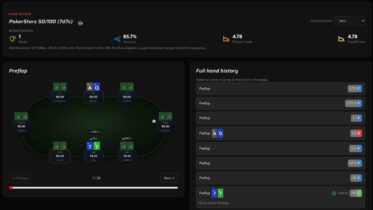
3. They use current tools in their teaching. Poker in 2026 is solved at a deeper level than it was five years ago. A coach who does not incorporate solver analysis into their work is teaching an outdated game. Look for coaches who use modern solver tools. At PokerCoaching, our coaches use PeakGTO (peakgto.com) as the primary solver for building and reviewing ranges, and you should expect that standard from any coach you hire.
4. Student reviews are specific and verifiable. Generic testimonials mean nothing. Look for student reviews that describe specific spots or leaks the coach identified and what changed afterward. If you can find forum threads or community posts where students discuss their experience with a specific coach, those are more reliable than polished quotes on a sales page.
5. The first session is collaborative, not a lecture. A good coach asks you questions. They want to understand your game before prescribing fixes. If a coach spends the whole first session telling you what they would do without first understanding your history and tendencies, that is a bad sign for how personalized the coaching will actually be.
The Value of One-On-One Poker Coaching
In my experience, one-on-one coaching is the fastest path to improvement for players who have already put in significant study time on their own. The reason is specificity. A video course addresses a general audience.
A one-on-one coach addresses your specific mistakes with your specific history at your specific stakes. The leaks a coach identifies in your first two sessions often pay for the coaching cost within a few weeks of corrected play.
Most poker coaching these days is done via video courses that players can purchase from the coaching sites and use at their leisure. However, one-on-one coaching is still very much a thing, and it may just be the most valuable type of poker coaching out there.

What one-on-one poker coaching can do for you, provided you find the right coach, is help you plug leaks in your own game you never knew existed.
A great poker coach will look over your hand histories, review your poker stats, and quickly realize where your biggest mistakes are coming from, allowing them to lead you the right way and fix those mistakes.
Even a few hours with a top-level poker coach can be invaluable, especially if you feel like you are struggling despite having a good understanding of the game overall.
One-on-one poker coaching can come at a high premium, which is why you should do a lot of research before paying for it, ensuring that you get the right coach for the game you are playing and the level you are currently playing at.
Once you land the right coach, talk with them to figure out how to approach your sessions and how best to optimize your time together.
The best thing about one-on-one coaching is that it is completely bespoke, allowing you to focus on anything you prefer and get the exact insights you were looking for.
When booking one-on-one sessions, it helps to know what session format will work best for you.
The most common formats are: a live sweat, where the coach watches you play in real time and comments on your decisions as they happen; a database review, where the coach pulls up your hand history from tracking software like PokerTracker and identifies statistical leaks across your full sample; and a video review, where you record hands beforehand and the coach provides detailed feedback on each play at his own pace.
For most players starting out with one-on-one coaching, a database review is the highest-value session because it identifies leaks you do not even know exist, rather than just fixing the spots you already know are troublesome.
Poker Coaching for Profit
I mentioned that coaching can be expensive, and I want to be direct about the profit-sharing model because I think it is genuinely underutilized by players who qualify for it.
The keyword is “qualify.” A staking arrangement is not charity. A backer or stable is looking for players with demonstrated potential who are currently bankroll-limited, not for players who have not yet proven they can beat the game.
If you are a consistent winner at your current stakes but genuinely cannot afford to move up, this model is worth pursuing seriously. If you are still losing, get coaching in another form first.
There are plenty of poker coaches out there who are willing to teach students for a cut of their profits, and some of them will even be willing to stake you.
If you are already a decent poker player, you may be able to find a poker stable (staking group) that will stake you for the games and provide coaching on a regular basis.
This kind of deal is the most affordable option, as it requires no investment on your part other than your time and commitment.
Of course, you will have to pay a cut of your profits to your coaches, but considering the fact you would never have made that profit without proper poker coaching, it is well worth it.
If you are interested in this kind of deal, do some research, and you will notice that there are plenty of people in the poker community who are willing to coach people on a deal like this, provided you are the right candidate.
Poker Coaching Never Stops
I am still learning. After over two decades of playing and coaching, I review hands, study new solver output, and update my thinking based on how the games are changing. I tell this to students not to be impressive but to make a point: the edge in poker goes to the person who stays curious. When you decide you have learned enough, someone else is studying the spots you stopped thinking about.
While nobody expects you to continue paying for poker coaching your entire life or constantly buy every poker coaching course that comes to market, you should never stop learning poker either.

Once you have reached the level you were hoping to reach and are happy with the poker coaching you have received, you will want to become your own poker coach.
By this time, you should be comfortable with using poker tools like PeakGTO, PIOSolver, ICMizer, or Poker Tracker, and you should continue using these tools on your own time to continue improving as a player.
If you allow yourself to become complacent, what will most likely happen is that players who continue investing time and money into poker coaching will get better than you.
While this does not mean you won’t be able to beat the game necessarily, it does mean your edges will fade over time until eventually they are gone altogether.
Always keep studying poker and improving, whether on your own, with your friends, or with occasional coaching sessions, if you want to stay relevant in poker and be able to crush your opponents.