
A donk bet in poker is when an out-of-position player leads with a bet into the preflop aggressor, instead of checking and allowing the aggressor to continue the action.
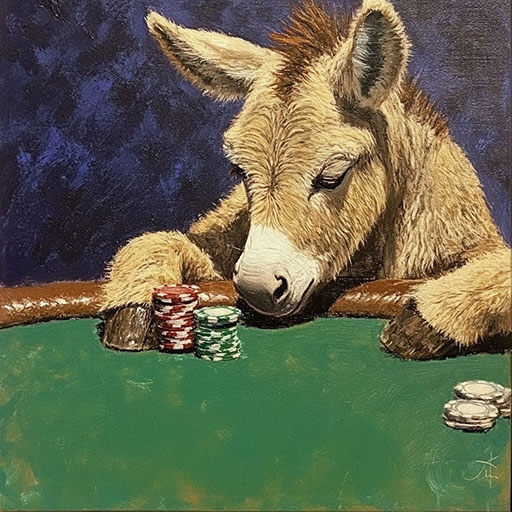
The play gets its name from “donkey,” the poker community’s term for a weak or novice player, because donk betting is associated with poor strategy and players who do not understand game flow.
I have reviewed thousands of hand histories in coaching sessions, and the donk bet is one of the most reliable tells that a Texas Hold’em player is operating on feel rather than strategy. That said, there are specific situations where it can make sense, and knowing those situations also tells you how to respond when opponents use it against you.
What Is a Donk Bet in Poker?
The name “donk bet” comes from the word “donkey,” which is typically used to describe a bad poker player who doesn’t really understand any poker strategy.
A donk bet refers to a bet made on the flop by the player who took a passive line before the flop and is out of position.
For example, the player on the button makes a raise to 3x the big blind, and the player in the big blind makes the call.
The flop comes As9d4c, and the player in the big blind comes out betting for 5 big blinds instead of checking, which would be the typical play.
A donk bet goes against the natural flow of the hand, which typically allows the preflop raiser to continuation bet on the flop.
Donk betting is usually associated with poor poker players and seeing a player donk bet often can be a good sign that they are not a very strong opponent to play against.
But how exactly do you deal with donk bets in your games? Before we can look into that, let’s talk briefly about why donk betting is not a good idea in the first place.
Why Donk Betting Is an Inferior Play
I can tell you exactly why elite players almost never donk bet: information asymmetry. The in-position player already has a structural advantage in poker.
Every time the out-of-position player acts first with a bet rather than a check, they hand over additional information to the player who is already winning the information war. It is the strategic equivalent of tipping your hand before the other player has to make any decision. The few situations where this trade-off makes sense are the exception, not the rule.
If you have ever watched high-stakes poker games with strong players on TV, you have probably noticed that the player who defends preflop in the blinds almost always checks the flop.
Checking the entire range as the defender is very often what a GTO-based strategy prefers, because it avoids revealing information about hand strength.
By leading with a donk bet, you tell your opponent something about your hand, whether you intend to or not, because it is nearly impossible to balance a donk-betting range properly.
To be truly balanced, you would need to include some donk bets with hands that have not connected with the board at all, and most players never do this. Instead, players who donk bet almost exclusively do so with draws or medium-value hands.
By donk betting, you tell the player in position that you have connected with the board, which allows them to fold all the air holdings they would have otherwise c-bet and gotten away cheaply from.
If we donk bet, the opponent can simply fold all the hands that have not connected with the board and that he could have otherwise c-bet with.
For example, imagine defending the big blind against a 3x raise from the button with As7c. The flop comes Ah7d3c. Instead of checking, you decide to fire out a 4bb bet.
Your opponent is now more or less forced to fold hands like KQ, JQ, JT, and many others that have not connected with this board at all while you are holding a monster.
On the other hand, had you checked, the opponent would be very likely to fire a c-bet, as the A-high flop favors their opening range.
Let’s take another example. You defend the big blind against the same player with 6s5s and the flop comes Jd4s3s. Once again, you fire out a 4bb donk bet on the flop.
Your opponent is once again forced to fold all sorts of hands that have not connected with the board, especially because you have alerted them that you have connected with the board.
On the other hand, your monster draw was strong enough for a check-raise, which would allow your opponent to fire with a hand like AK or KQ and then have to fold it to your raise, earning you an additional bet.
In most cases, a donk bet is an inferior play to a check, but let’s check out a few scenarios in which such a play can actually be the right way to go.
Can a Donk Bet Make Sense?
This is the part most players get wrong: they think donk betting can save them from passive lines. It almost never does. The situations where I find donk betting to be the correct play are narrow and almost always involve two conditions: a board texture that genuinely favors the defender’s range, and a specific strategic reason to prevent the opponent from controlling the pot size with a c-bet.
The problem with donk betting is that most players don’t use this play at the right time and instead try to make a donk bet when they don’t want to see the flop checked through.
A donk bet never makes sense on any A or K-high board, as such a board heavily favors the raiser’s range. The same can be said for boards with multiple Broadway cards.
On the other hand, low and middle connected boards can give you some space for a donk bet, but only with a well-crafted range.
Such a poker ranges would have to include a number of both value and bluffing hands merged into one single donk-betting range.
For instance, on a board of 6h5h3d, you would want to donk out with any number of single pairs, two pairs, sets, straights, and draws to balance the range out.

On the other hand, you could simply check all these hands and then play them accordingly, facing a c-bet or on the turn when the flop checks through.
One scenario in which donk betting makes a lot more sense is when the hand goes multi-way, and you flop a strong draw or a strong made hand in the blinds.
While donk betting in this situation does somewhat advertise your hand as strong, it also allows you to protect your poker equity and make your opponents pay for their draws.
By checking your nuts in a 4-way pot, you allow your opponents to check back and realize their equity for free, which is usually not a good idea.
When donk betting does make sense, bet sizing matters significantly. A small size in the range of 25 to 30 percent of the pot allows you to keep both value hands and bluffs in the range, because it does not commit enough chips to make your range transparent.
A large donk bet polarizes your range immediately and makes you very exploitable against attentive opponents. Additionally, donk betting becomes more justified when your opponent is known to c-bet at an extremely high frequency (above 70 percent in most spots), because at that point their range is wide and includes many hands that will fold to any aggression.
Against a solver-calibrated opponent with balanced c-bet tendencies, check-raising almost always outperforms a donk bet.
So, if you are ever going to donk bet, do so in multi-way pots where your hand rates to be the best or your draw has a good chance of making the nuts if called.
Turn Donk Bets: When They Actually Make Sense
Everything discussed above focuses on flop donk bets, which are almost always the wrong play. Turn donk bets operate under different conditions and can be a legitimate part of a well-constructed strategy in specific spots.
The key difference is board interaction. On the flop, both players are still evaluating a board that arrived without context. On the turn, a new card has landed, and that card can significantly shift the equity distribution between the two ranges. If a turn card heavily favors the out-of-position player’s range, a donk bet is no longer just a defensive play. It is a value-extraction tool that beats waiting for the in-position player to bet.
The situations where I use turn donk bets are narrow but clear:
- The turn card completes a draw you represented: If you defended the big blind and checked a flush draw on the flop, and the flush completes on the turn, donk betting with your made flush (and some bluffs) extracts value from opponents who might check back with overcards if you check.
- The turn card dramatically shifts range advantage: On boards where the preflop raiser’s range is heavy with overcards and high-card hands, a low turn card that connects with the defender’s more balanced calling range creates a spot where a donk bet puts maximum pressure on a range that is now at a disadvantage.
- Multi-way pots with a new scare card: In multi-way situations, a turn donk bet can serve as protection for made hands that do not want to allow multiple opponents to check back and realize equity.
Working through turn donk bet scenarios in a solver like PokerCoaching’s own PeakGTO is one of the most efficient ways to identify which specific turn cards create these opportunities in the game trees you face most often. The frequency is low even in theory, but the spots are learnable and valuable.
Dealing with Donk Bets in Poker
Now that I have covered why you should avoid donk betting in most situations, the more profitable question for most players is: what do you do when someone donk bets into you?
In my experience, most of the donk bets you will face in a real game come from recreational players who donk bet draws, two-pair hands, or sets because they are afraid of getting check-raised off their hand. Understanding this tendency is where the real exploitation money is.
In most cases, the players donk betting into you will not be terribly advanced, which is why you get to play fairly straightforward against them.
The biggest exploit you can make when facing a donk bet against an unknown player is to let your hand go unless you are very strong on the flop.
For instance, if you raise AsKs, the flop comes 8d7c4c, and your opponent donk bets into you, letting the hand go could be a good plan.
On the other hand, it is also important to recognize that most players don’t donk bet their nutted hands either and will usually be donking with a draw or a relatively weak value hand.
If you happen to have a drawing hand yourself, a big raise on the flop can give them bad pot odds and often get your opponent to lay down their hand. The best part about this is that even when your opponent does call, that is still a great result for you as they are making a large mathematical error.
For instance, on the same board as above, you could easily make a big raise with AcQc and get your opponent to fold a hand like 8s5s quite often.
If you play with the same group of players often, you may be able to pick up on the tendencies of certain players to donk bet a lot of their medium-value hands.
Once you spot this, you can relentlessly raise against such donk bets and get the player to fold over and over to you for quite a while.
While this plan can occasionally backfire if the player catches up and traps you with a monster, you will win the pot outright much more often and compensate for the occasional loss.
Donk Betting in a Nutshell
My advice on donk betting is simple: do not add it to your game until you have a strong enough understanding of range construction to build a balanced donk range that includes both value hands and bluffs across multiple board textures.
That is a high standard to meet, and most players are better served by mastering check-raise strategy first. The exploitative edge available from well-timed check-raises against players who c-bet too much is larger than almost any edge available from selective donk betting.
A donk bet is a play usually utilized by inexperienced poker players or those who don’t understand poker strategy at a high level, and you can easily go your entire poker career without ever donk betting.
While the play can make some sense in multi-way pots, it is almost always the inferior choice in heads-up play and should be avoided.
If you find yourself facing a lot of donk bets from your opponents, make sure to keep a close eye out to figure out the range of hands they like to donk bet with.
Once you master this, you will be able to make extremely exploitative plays that will leave your opponents in the dust and allow you to completely dominate them.
As far as donk betting goes on your part, try to avoid this play for the most part and learn how to play out of position while checking your entire range on the vast majority of boards.