

Types of poker games fall into three main categories: community card games like Texas Hold’em and Omaha, stud games like Seven-Card Stud and Razz, and draw games like Five-Card Draw and Badugi.
Each category uses different poker rules, dealing structure, betting format, and hand-reading skill set. I have coached thousands of players over the years, and what I consistently find is that learning even one additional poker format sharpens how you think about the game across all variants.
- Texas Hold’em Poker
- Pot-Limit Omaha (PLO)
- Omaha Hi-Lo (Omaha 8 or Better)
- Short Deck Poker (6+ Hold’em)
- Seven Card Stud
- Razz (Seven Card Stud Lowball)
- Five Card Stud
- Five Card Draw
- Big O (Five-Card Omaha Hi-Lo)
- Pineapple Poker
- Badugi
- Mixed Poker Games (HORSE and 8-Game Mix)
- Conclusion
- Frequently Asked Questions About Types of Poker Games
Texas Hold’em Poker
Texas Hold’em is the world’s most popular poker game that you see on TV and at the biggest live events, such as the World Series of Poker.
In Hold’em, each player gets two “hole cards” that only he can use and combine them with five community cards to make the best five-card hand.
The game consists of four betting rounds (pre-flop, flop, turn, and river), during which each player decides whether to bet, fold, call, or check based on their hand and the situation at the table. In the No-Limit format, you can bet all your chips at any time.
Thanks to its simple rules and fast action, No-Limit Texas Hold’em became the number one poker game worldwide after the 2000s poker boom.
Top 3 Tips for Texas Hold’em
Hold’em is the game I have spent the most of my career studying and coaching, and the single biggest mistake I see beginners make is playing too many starting hands preflop. These three adjustments make the biggest difference first:
- Play strong starting hands: Be selective and play only strong hands preflop, and this alone will put you above most players who are just starting and make costly mistakes of playing too many holdings.
- Use your position: Play more hands in position, as you will always know what your opponent does before making your decision, giving you a significant advantage.
- Don’t bluff too often: Bluffing is a thrilling part of poker, but beginners should concentrate on playing strong hands and avoid fancy plays.
Texas Hold’em is the ideal starting point for learning poker. Mastering it will give you a solid foundation before you explore other poker variants.
Texas Hold’em Rating – 8/10
This action-packed game is easy to learn and widely available, so you won’t have trouble finding a place to play. On the other hand, it has high volatility and intense competition, so it’s best to be prepared when you sit down.
- Easy to learn: 8/10
- Fun: 6/10
- Popular: 10/10
Pot-Limit Omaha (PLO)
Pot-Limit Omaha is the second most popular poker variation after Hold’em. At a glance, Omaha looks like a similar game as it uses flop, turn, and river community cards and the same hand rankings.
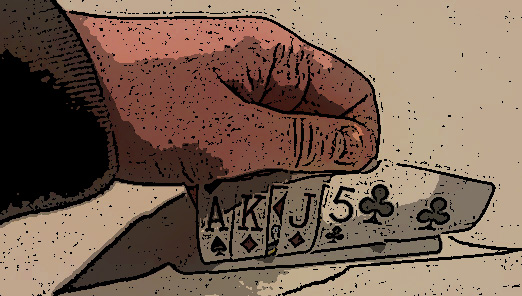
The big difference is that in Omaha, each player gets four hole cards instead of two. You must use exactly two of your four hole cards and three of the community cards to form your hand at showdown, which significantly changes the game flow.
Omaha is typically played as a Pot-Limit game, meaning you can bet up to the current size of the pot.
With twice as many hole cards, you will make stronger hands more often, play massive pots, and have bigger swings. In fact, PLO has a reputation as an “action game” with lots of betting and draws. Skilled Omaha players learn to be selective, but many newcomers love it for the gambling thrill.
Top 3 Tips for PLO
PLO is one of the most misunderstood games I teach, because players bring their Hold’em instincts to the table and consistently overplay marginal hands. The adjustments that actually move the needle early:
- Focus on quality starting hands: Aim for hands that work together, like double-suited or connected cards, and avoid playing random combinations.
- Don’t overplay weak draws: Always be aware of the current nuts and do not overplay the draws that won’t be able to make the best possible hand.
- Control the pot size: Since Omaha is pot-limit, use betting to your advantage and protect vulnerable hands by betting big, but do not overplay marginal holdings.
Once you get used to the nuances, PLO is an incredibly fun poker variation that offers a fresh challenge beyond Hold’em. It’s a favorite of many seasoned players and high rollers for its mix of skill and gamble.
PLO Rating – 7.3/10
PLO has a much steeper learning curve at the beginning and involves more complex decisions with higher variance. That being said, it offers lots of action and is usually considered more fun to play.
- Easy to learn: 6/10
- Fun: 9/10
- Popular: 7/10
Omaha Hi-Lo (Omaha 8 or Better)
Omaha Hi-Lo is a popular split-pot variant of PLO. It follows the same dealing and betting structure as Pot-Limit Omaha, but the pot is split between the highest and the lowest hand.
In other words, there can be two winners at the showdown. One takes the “high” half of the pot according to standard hand rankings, and one takes the “low” half. To qualify for the low, a hand must have five cards ranked 8 or lower (hence “8 or Better”), with no pairs. If no player can make a qualifying low, the high hand scoops the entire pot.
Omaha Hi-Lo is typically played in Limit or Pot-Limit format. This game adds an extra layer of strategy since players often try to “scoop” the pot by winning both the high and low halves.
Starting hands that can make both strong highs and lows are most valuable. Due to its split-pot nature, Omaha Hi-Lo can have many players staying in to chase one half of the pot, resulting in large pots. It’s a favorite in mixed-game among players who enjoy strategic, multi-faceted poker.
Top 3 Tips for Omaha Hi-Lo
Omaha Hi-Lo is a game where I see even experienced players lose money consistently by chasing half the pot with hands that cannot scoop. The strategic concepts that separate the winners from the field:
- Play “two-way” hands: Focus on starting hands that have potential for both high and low. For example, A-2-K-K double-suited can make a nut low (A-2 for low) and a strong high (K-K for a set or high flush). Hands that can only win one side (only high or only low) are less valuable – you want to scoop pots, not just split them.
- Beware of low traps: Holding the bare A-2 (the best two low cards) is powerful, but if the flop doesn’t support a low (e.g. flop comes all high cards) or if someone else also has A-2, you can get in trouble. Don’t overcommit with just a low draw when the board is paired or might give someone a full house for high – you could end up only getting a quarter of the pot if multiple players share the low.
- Push nut advantages: When you have the nut low and a good high draw (or vice versa), be aggressive. For instance, if you’re drawing to the nut flush while holding A-2 for nut low on a flop like 3♠ 7♥ K♠, you’re in a freeroll situation – even if your flush misses, you have the nut low secured. These are spots to put pressure on opponents because you have a safety net of winning at least half the pot and a chance to win it all.
Omaha Hi-Lo is a very entertaining poker variant once you get the hang of it. It teaches you to think about hands in multiple dimensions and can be quite profitable against unskilled opponents.
Omaha Hi-Lo Rating – 6/10
Omaha Hi-Lo can be confusing for beginners since it requires a lot of calculations and often results in chopped pots. That being said, you can potentially have a significant skill advantage if you master this game, resulting in lower variance and higher win rates.
- Easy to learn: 5/10
- Fun: 8/10
- Popular: 5/10
Short Deck Poker (6+ Hold’em)
Short Deck Hold’em, also known as 6+ Hold’em, is a modern poker variant that has gained popularity in high-stakes circles over the last decade. It is essentially a twist on Texas Hold’em that uses a 36-card deck instead of the standard 52 cards.
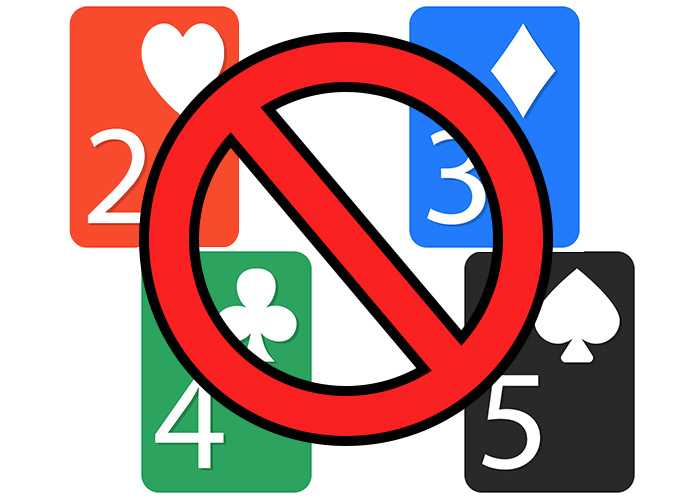
In Short Deck, all the 2s, 3s, 4s, and 5s are removed from the deck, hence the name “6+”. The gameplay is the same as Texas Hold’em, but the altered deck significantly alters hand probabilities. It becomes much easier to trips or straights and harder to make flushes.
Therefore, Short Deck often employs a slightly different hand ranking where flushes beat full houses in many Short Deck games. Also, in Short Deck, an Ace can still play as high or low in a straight, so the lowest straight is A-6-7-8-9 since the 5 is missing from the deck.
Short Deck poker is known for action and volatility. With the smaller deck, everyone’s hole-card holdings are inherently stronger on average, and hand equities run closer. This means you’ll see more frequent big hands and more all-in confrontations.
Top 3 Tips for Short Deck Poker
Short Deck is the game where I have seen the most confident Hold’em players get humbled fast, because the hand rankings shift in ways most players do not properly account for before sitting down. Here is what to adjust first:
- Recalibrate your starting hands: In Short Deck, middling hands go up in value. For example, pocket jacks or queen-jack suited are stronger than they would be in Texas Hold’em.
- Draw aggressively: Since equities run closer, drawing hands like open-ended straight draws or flush draws are very powerful in Short Deck. In fact, some draws are almost coin flips against made hands.
- Manage your bankroll: The swings can be really wild in Short Deck, so always manage your bankroll properly and only play in the games you can afford.
Short Deck is an exhilarating poker variation that will test your adaptability. It’s fast, fun, and volatile, making it a favorite for action-loving players.
Short Deck Rating – 7/10
Short Deck Holdem offers much higher variance with a lower possible skill edge for regular players. That being said, it is an extremely fun and action-packed game that makes most decisions quite simple.
- Easy to learn: 7/10
- Fun: 9/10
- Popular: 510
Seven Card Stud
Before Texas Hold’em took over the world, Seven-Card Stud was the most popular variation. It’s a classic game with no community cards, where each player receives their own seven cards.
The game is almost always played with a fixed-limit betting structure. Each player antes a small amount, and then is dealt 7 cards through five rounds: two cards face-down and one face-up to start, then three more face-up cards dealt one at a time, and finally one last card face-down. At showdown, you choose the best five of your seven cards to determine the winner.

Stud has no blinds as you would find in most popular games and instead uses an ante from each player and a forced “bring-in” bet. On the initial deal, the player with the lowest up-card must post a small bet to start the action. On each subsequent deal, the highest hand showing on the board acts first. This means the turn order can change from round to round depending on whose up-cards make the best hand at that point. It’s a unique dynamic of stud games.
Stud is typically slower-paced and more methodical than Hold’em, but it offers a deep sense of poker strategy and was the proving ground for many old-school poker legends.
Top 3 Tips for Seven-Card Stud
Stud was the game poker legends built their careers on, and what I notice most when coaching it today is how few modern players take card memory seriously enough. The three principles that matter most:
- Starting hand discipline: Only play strong starting hands, such as holding a pair, all big cards, or three to a straight or flush combination.
- Use your position: In stud, “position” is a bit different as it’s determined by who has the high hand showing. However, acting last in a round is a significant advantage, so find ways to capitalize on it.
- Fold on later streets if you’re clearly beaten: This sounds obvious, but many stud novices chase the “dead” hands too often. Because there are five betting rounds, calling down with slim hopes can bleed your chips.
Seven Card Stud Rating – 5/10
Short Stud is a slow-paced game that requires memorizing the cards and has limited bluffing opportunities, making it less exciting. On the flip side, it is beginner beginner-friendly game that has much lower variance, so it can be a fun one to try with your friends.
- Easy to learn: 6/10
- Fun: 6/10
- Popular: 3/10
Razz (Seven Card Stud Lowball)
Razz is essentially a lowball Seven-Card Stud variation. In Razz, the goal is to make the lowest five-card hand possible. Straights and flushes don’t count against you, and Aces are low, meaning the best possible Razz hand is 5-4-3-2-A.
If you’re coming from Hold’em/Omaha, think of Razz as upside-down poker. You want to avoid pairs and high cards, which are preferable holdings in other games.
In Razz, the worst up-card starts the betting instead of the best. Each player gets 7 cards (three down, four up) over five betting rounds in a fixed-limit format, and the lowest hand wins the pot.
Top 3 Tips for Razz
Razz is the game that most exposes discipline problems, because everything you have been trained to want — high cards and pairs — suddenly hurts you. Here is what the adjustment looks like in practice:
- Be picky with starting hands: In Razz, a strong starting three-card hand is crucial. You generally want three cards 8 or lower with no pairs.
- Watch exposed cards: Because each player’s up-cards are visible, use that information to your advantage when making decisions on when to continue with your hand.
- Steal when you can: If you have the lowest up-card showing on the table and everyone checks to you, a bring-in steal is often worthwhile.
Razz is a unique poker game that flips the script on traditional hand values. It might not provide adrenaline moments to the same extent as no-limit games, but it offers a refreshing test of patience, memory, and lowball strategy.
Razz Rating – 6/10
Razz is quite limited in availability and can also be quite slow for players accustomed to fast-paced action. On the other hand, it is an easy game to learn for observant players and gives you the opportunity to have a significant edge over others.
- Easy to learn: 6/10
- Fun: 8/10
- Popular: 4/10
Five Card Stud
Five Card Stud predates the 7-card version and was widely played during the 19th century during the American Civil War. In this variation, each player gets only five cards in total, with one downcard and four upcards, and there are four betting rounds.
Everyone antes just like in 7-card Stud, and each player gets two cards to start, one down, one up. The lowest upcard brings in the first bet, then one card is dealt face-up each round, with betting until the final card. In the end, the best five-card hand wins.
5-Card Stud is a very straightforward game. There are no draws, no community cards, and you only ever have five cards. Because of the limited cards, hand values tend to be lower – often a single pair or even high card wins in 5-Card Stud, especially if the pair is hidden.
Today, 5-Card Stud is not very popular, but it’s a good game to teach absolute newcomers due to its simplicity.
Top 3 Tips for Five Card Stud
Five Card Stud rarely shows up at modern tables, but in my experience the player who tracks all visible upcards with precision has a significant and consistent edge when it does. Three simple principles carry almost all the weight:
- Keep track of upcards: With so few cards, it’s easy to notice what everyone has and remember this when making decisions.
- Hidden pair is gold: If your hole card pairs one of your upcards, that’s often a monster in 5-Card Stud.
- Fold marginal boards early: With only five cards, drawing slim is usually not worth it.
Five-Card Stud is a nice piece of poker history and a straightforward game that can be enjoyable in the right setting.
Five Card Stud Rating – 5/10
Five Card Stud is rarely played anymore and is very limited in strategy, making it a bit boring for most players. On the positive side, it is extremely simple to learn and can serve as a good introduction for new players.
- Easy to learn: 8/10
- Fun: 5/10
- Popular: 2/10
Five Card Draw

If Texas Hold’em wasn’t your first poker game, then Five-Card Draw probably was. This is the classic “home game” that many people learn as kids. Each player is dealt five cards face down, and then there’s a round of betting.
After that, players can discard as many cards as they want and draw new ones to replace those. There’s one more round of betting, then a showdown where the best five-card poker hand wins.
Five-Card Draw has no community cards so it’s all in your hand and your poker face. Because opponents cannot see any of your cards, it’s a game that heavily emphasizes bluffing and reading.
While Five Card Draw used to dominate poker tables a long time ago, it’s now rarely played at a serious level. However, it remains one of the most entertaining casual poker games, and even some online poker sites offer it.
Top 3 Tips for Five-Card Draw
Five Card Draw is the game where reading opponents matters more than in almost any other format, because the draw mechanic is an information goldmine that most players ignore. Three keys I emphasize when coaching this game:
- Choose your discards wisely: Draw to strong hands by keeping high cards when you do not have any made combinations.
- Use the draw as a source of information: Pay attention to how many cards each opponent draws.
- Bluff in position after the draw: In Five-Card Draw, a lot of pots are won with a simple bet after the draw when others miss.
Five Card Draw is a must-try poker game for the experience, and it remains one of the most fun ways to gamble with friends.
Five Card Daw Rating – 7/10
There are very few strategic considerations and a significant amount of luck involved in this variation. That being said, it is extremely fun to play and easy to learn, making this game a perfect candidate for your home games.
- Easy to learn: 9/10
- Fun: 8/10
- Popular: 4/10
Big O (Five-Card Omaha Hi-Lo)
In a nutshell, Big O is Omaha Hi-Lo with five hole cards instead of four. By giving each player an extra card in their hand, Big O ramps up the complexity and possibilities of Omaha Hi-Lo even further.
Just like in regular Omaha Hi-Lo, you must use exactly two of your five hole cards and three community cards for both your high hand and low hand. To qualify for a portion of low hand, you need to have an 8-high or lower combination.
Since you have five cards, the number of 2-card combinations in your hand is huge, which means stronger hands are typically needed to win. Big O is known for big pots and big swings.
It’s not uncommon in Big O to see one player holding the nut high and another holding the nut low and both pumping money in, only to have a different player swoop in with an unexpected combination that wins one side or both. While this might appear to be a gamblers’ paradise, the game actually requires significant strategic knowledge for selecting the right hands and accurately evaluating different board textures.
If you love Omaha Hi-Lo, Big O might be your next favorite since it’s basically Omaha8 on steroids.
Top 3 Tips for Big O:
Big O is the most punishing game I know for players who commit to second-best hands, because with five hole cards the nuts are nearly always represented somewhere at the table. Here is the discipline that gives you an edge:
- Starting hand selection is paramount: Big O hands should ideally contain nut components. For example, if you don’t have A-2 or at least A-3 suited for a low part of the hand with other good cards, think twice.
- Aim to scoop, but don’t be greedy: The mantra in any Hi-Lo game is “scoop or at least secure one half solidly.” In Big O, this often means being cautious if you’re only drawing to half.
- Respect the nuts: With five cards, second-best hands often lose, so try to draw to nuts whenever you play a big pot.
Big O is an intense poker variation that can be incredibly fun if you enjoy split-pot games. It’s perhaps the ultimate test of your Omaha skills.
Big O Rating – 5.6/10
This is one of the most challenging games for beginners and is an extremely volatile variation. At the same time, it offers huge pots, a lot of action, and deep strategic considerations, making it a perfect game once you grasp the basics.
- Easy to learn: 5/10
- Fun: 8/10
- Popular: 4/10
Pineapple Poker
Pineapple is a Hold’em variant where each player receives three hole cards instead of two, then discards one card after the flop. The rest of the hand plays out exactly like Texas Hold’em, using two hole cards and five community cards to form the best five-card hand.
The discard decision is what makes Pineapple strategically interesting. With three cards preflop, you will hit the flop more often, and deciding which card to release creates a layer of decision-making that Hold’em players find refreshing without requiring a new hand-ranking system.
Crazy Pineapple is a popular variation where players hold all three cards through the flop betting round before discarding, creating larger pots and bigger swings. Pineapple plays particularly well in home game settings where softer competition makes the extra card even more impactful.
Top 3 Tips for Pineapple
Pineapple is the game I point to when students want a change from Hold’em without learning an entirely new format. The transition is fast, and these three concepts make the most difference:
- Think beyond the current board when you discard: The card you release should account for your likely equity on the turn and river, not just how well it connects with the flop right now. Players who discard only to the current board consistently make short-sighted decisions.
- Exploit your draw equity aggressively: With three starting cards, draws come in more often and run stronger. When you flop a strong draw in Pineapple, the equity math frequently justifies betting that would be excessive in Hold’em.
- Use the draw as an information source: Opponents held three cards preflop and discarded one. Paying attention to discard timing and subsequent betting patterns gives you range-reading information that standard Hold’em does not offer.
Pineapple Rating
Pineapple is one of the fastest games to pick up for any Hold’em player and is an excellent addition to home game rotations where the fun factor matters as much as the strategy.
- Easy to learn: 8/10
- Fun: 8/10
- Popular: 4/10
Badugi
Badugi is a unique poker variant originating from Asia. In Badugi, each player is dealt four cards, and the goal is to form the lowest hand possible. The twist is that all four cards must be of different suits and unpaired.
The best Badugi hand you can have is A-2-3-4 of all different suits. That is the nut Badugi.
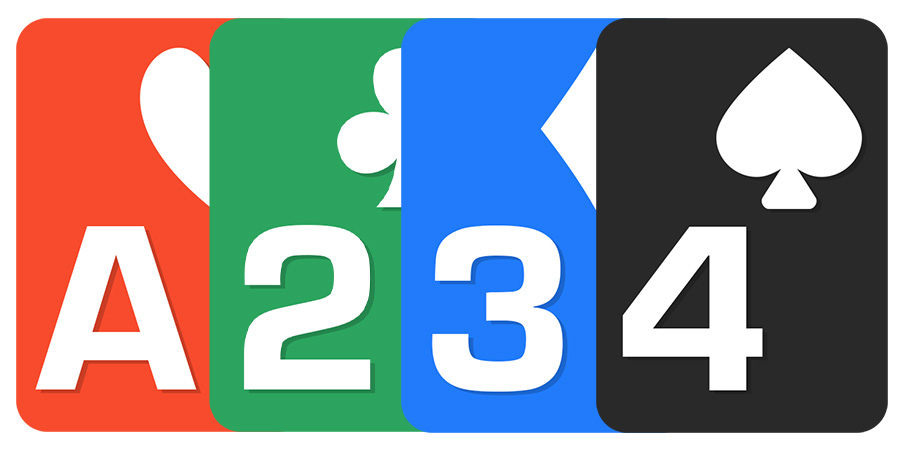
Badugi is a triple draw game, usually played in fixed-limit. This means there are three drawing rounds. You receive your four cards, followed by a betting round. Then, you may discard any number of cards and draw new ones, repeating this flow two more times.
At showdown, whoever has the lowest Badugi wins. For example, a hand like 7♣-5♥-4♦-2♠ is a 7-5-4-2 Badugi, which would beat an 8-3-2-A Badugi.
The fun of Badugi lies in its distinct hand ranking and the draw element. It’s a refreshing change because flushes and straights are irrelevant.
Top 3 Tips for Badugi:
Badugi is one of those games where I consistently find soft spots, because so few players have studied it seriously enough to understand the equity of a three-card hand versus a four-card Badugi. Three things that give you an advantage:
- Starting hand selection: Good starting hands are ones with three low unpaired cards of different suits.
- Know when to stand pat: If you have a decent Badugi, say 8 or lower, after the second draw, you should often stand pat and act as if you have a winner.
- Observe draw tendencies and position: If you draw last, you get to see how many cards opponents draw before deciding what to do, so utilize that information.
Even though finding games might require some effort, learning Badugi will round out your skills and provide a refreshing poker experience when you want a break from the usual variants.
Badugi Rating – 6/10
The biggest disadvantage of this variation is that it is quite tough to find the games running, and they can actually be quite swingy. On the positive side, it is a very fast-paced and fun game once you get the hang of it.
- Easy to learn: 7/10
- Fun: 8/10
- Popular: 3/10
Mixed Poker Games (HORSE and 8-Game Mix)
Mixed games cycle through multiple poker variants in a fixed rotation, requiring players to shift gears completely between formats at regular intervals. The most famous mixed game is HORSE, which rotates through Texas Hold’em, Omaha Hi-Lo, Razz, Seven-Card Stud, and Stud Eight-or-Better. The 8-Game Mix, popular in high-stakes online games and the World Series of Poker, adds No-Limit Hold’em, Pot-Limit Omaha, and 2-7 Triple Draw to the rotation.
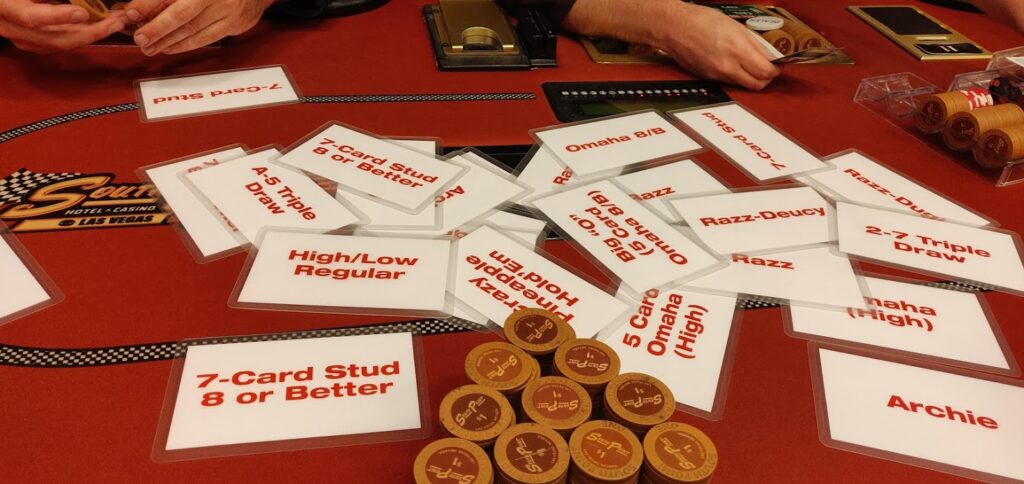
In mixed games, a new format begins at the start of each orbit or after a set number of hands. The structure forces players to adapt constantly. Unlike single-format games where specialization works, mixed games reward breadth. The player who wins in the long run is the one with the fewest glaring weaknesses across the entire rotation.
Mixed games are common at the highest stakes in poker. The WSOP offers HORSE events and multiple 8-Game Mix events annually, and high-stakes online poker rooms consistently run these formats because they attract the most well-rounded poker minds in the game.
Top 3 Tips for Mixed Games
Mixed games are where the edges tend to be largest, because most players have serious skill gaps in at least one or two formats. I find that students who prioritize mixed games improve faster overall because it forces them to think about poker abstractly rather than relying on format-specific habits. Here is what I focus on:
- Identify your weakest game and study it first: Before your next HORSE session, rank the five formats by your own comfort level. The one you feel worst about is where you are giving money away every rotation. Focused study on your weakest game yields faster results than polishing your strongest.
- Exploit players who coast through their weak format: Most opponents in mixed games play tight and passively in the variants they are uncomfortable with. When the game rotates to their weak format, open your aggression range. Many players give up equity automatically when they are in uncomfortable territory.
- Use a solver for each format separately: PokerCoaching’s own solver, PeakGTO (peakgto.com), covers multiple poker formats, making it an efficient tool for working across all the games in a single rotation without switching between different software tools.
Mixed Games Rating
Mixed games are my favorite setting for identifying serious poker talent, and they will humble players who dominate single-format tables quickly. For any player serious about long-term poker improvement, building competency across formats is one of the highest-leverage study investments available.
- Easy to learn: 4/10
- Fun: 9/10
- Popular: 5/10 (concentrated at higher stakes)
Conclusion
Every variant on this list tests a different skill. Hold’em rewards aggression and position. Stud rewards memory and patience.
Draw games reward reads and deception. I have played all of these formats at meaningful stakes, and the honest truth is that learning even one game beyond Hold’em will change how you think about poker across everything you play.
Start with whatever variant looks most interesting from this list, put in a few sessions, and pay attention to what transfers back to your main game. The skills compound in ways most players never discover because they never look past the first format they learned.