
GTO poker, short for game theory optimal, is a strategy that can’t be beaten in the long run. Whatever your opponents do, they can at best break even.
Most players hear that and picture a robot copying solver outputs, but that’s not how strong players use it.
GTO is a way of thinking about ranges, bet sizes, bluffing frequencies, and it gives you a solid default for every spot you haven’t studied.
This guide explains GTO poker in Texas Hold’em, how it differs from exploitative play, the few concepts that actually matter, and simple rules you can use at the table without ever opening a solver.
What Is GTO Poker?
A GTO strategy is the poker version of an equilibrium. If two players both played it perfectly, neither could gain by changing anything. Each would just break even, before the rake.
That gives GTO its most useful property. It can’t be exploited. Your opponent can’t find a leak in it, because it doesn’t have one.
It’s worth being precise about what that means. A GTO strategy never loses to an opponent in the long run, and it wins when opponents make mistakes, like calling with hands that should fold.
But it doesn’t go out of its way to attack a specific opponent’s leaks. Against someone who folds far too often, GTO keeps bluffing at its normal frequency instead of bluffing every hand. That’s the job of exploitative play.
Nobody has solved full no-limit Hold’em. The game is too big. We have solver approximations for specific spots, and that’s more than enough to learn from.
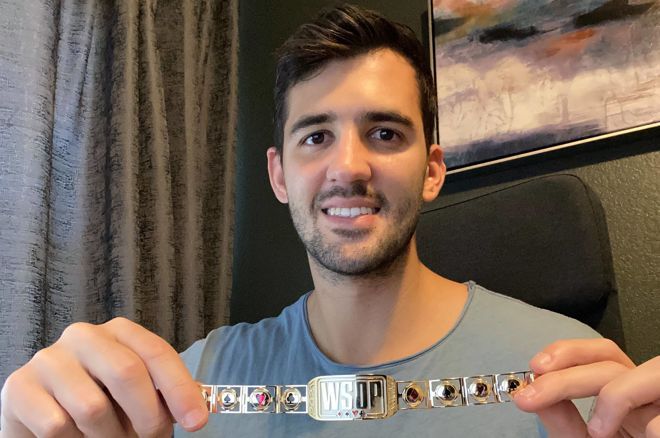
One of the best poker players in the world under the age of 30,
PokerCoaching.com coach Justin Saliba has built a career on playing GTO poker.
GTO vs Exploitative Poker
Exploitative poker means changing your strategy to attack a specific opponent’s mistakes. If a player never bluffs the river, you fold more against their river bets. If a player folds too much, you bluff more.
Exploiting a weak player usually wins more than GTO does. The cost is that you become exploitable yourself. If your opponent notices and adjusts, the edge can flip.
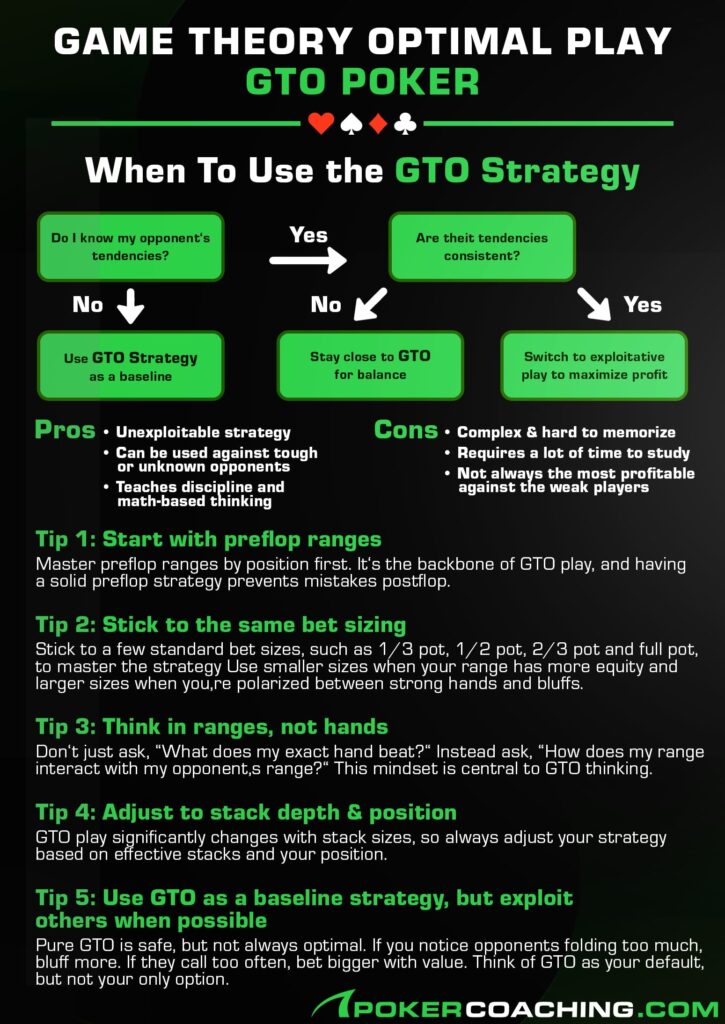
So the two work together. GTO is the baseline you fall back on when you don’t know your opponent or when they’re strong. Exploits are the deviations you make once you’ve seen a real leak. You can’t know how far to deviate until you know where the baseline is. Our guide on mixing GTO and exploitative poker goes deeper on when to switch.
How Solvers Find GTO Strategies
A solver is software that calculates an approximate GTO strategy for a spot you set up. You give it both players’ ranges, the stack sizes, the board, and the bet sizes allowed, and it works out how often each hand should check, bet, and at which size.
PokerCoaching’s own solver is PeakGTO, and other tools work the same way. Solvers are for study only. Using one while you play is against the rules of online poker sites and live card rooms.
When I study with a solver, I’m not trying to memorize that a hand bets 37% of the time in one exact spot. I’m trying to understand why it does, so I can carry the idea into the hundreds of spots I’ll never study directly. That’s the difference between players who improve from solver work and players who just collect outputs.
The GTO Concepts That Actually Matter
Thinking in Ranges
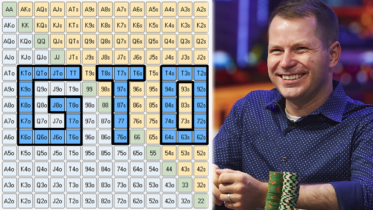
A range is every hand a player could have in a spot, given the action so far. GTO strategies are built range against range, not hand against hand.
This is the biggest practical change GTO brings. Instead of “he has ace-king,” you think “he has these hands, and my bet does this against all of them.” Every action narrows a range, and reading that narrowing is most of the skill. Our guide to poker ranges covers how to build and read them.
Mixed Strategies
Solvers often play the same hand in more than one way. A hand might bet 60% of the time and check 40%. Those hands are usually close to break-even between the options, and mixing them keeps your ranges from becoming predictable.
You don’t need to copy the exact percentages. If a hand mixes, either option is fine. Pick the one that works better against the opponent in front of you.
Balance and the River Bluff Ratio
On the river, a balanced betting range has the right mix of value bets and bluffs for its size. The bigger the bet, the more bluffs you can have, because your opponent is getting a worse price to call.
| River bet | Opponent needs to win | Bluffs in a balanced range | Rough ratio |
|---|---|---|---|
| 1/3 pot | 20% | 20% | 1 bluff for 4 value bets |
| 1/2 pot | 25% | 25% | 1 bluff for 3 value bets |
| Full pot | 33% | 33% | 1 bluff for 2 value bets |
| 2x pot | 40% | 40% | 2 bluffs for 3 value bets |
These numbers come from simple pot odds. They apply to a polarized river bet, where you either have a strong hand or a bluff. On earlier streets your bluffs still have equity, so the ratios don’t apply in the same way.
The Indifference Principle
Here’s why balance works. Say you bet $100 into a $100 pot on the river. Your opponent has to call $100 to win $200, so they need to win 33% of the time.
If exactly one third of your betting range is bluffs, their call wins one time in three. They win $200 once and lose $100 twice, which nets to zero. Calling and folding are worth the same. That’s what indifferent means.
You aren’t mixing in bluffs to be tricky. You’re doing it so that no response from your opponent makes them money. Bluff more and they profit by calling everything. Bluff less and they profit by folding everything that isn’t strong.
Minimum Defense Frequency
Minimum defense frequency (MDF) is the share of your range you need to continue with so that your opponent can’t profit by betting any two cards. The formula is pot divided by pot plus bet.
| Bet size | Minimum defense frequency |
|---|---|
| 1/3 pot | 75% |
| 1/2 pot | 67% |
| 2/3 pot | 60% |
| Full pot | 50% |
Use MDF as a warning light, not a rule. It assumes your hands can realize their equity, which isn’t true when you’re out of position with weak hands that will fold to later bets. After the flop, especially out of position, folding more than MDF suggests is often correct. Where it helps most is on the river, and when you notice you’re folding far more than it suggests against a player who bets a lot.
How to Use GTO Without a Solver
You don’t need to memorize solver outputs to play a sound game. These rules get you most of the way.
Start Before the Flop
Preflop is the easiest place to play close to GTO, because the spots repeat. Learn the opening and 3-bet ranges for your format and stack depth from good charts. Our preflop charts are a free starting point, and a small preflop leak repeated every orbit adds up fast.
Bet Small and Often When the Board Favors You
When the flop favors your range, like a king-high dry board after you raised from early position, you can bet a small size with most of your range. Your opponent has few strong hands and lots of weak ones that can’t stand much pressure.
Bet Big When You Have the Strongest Hands
When you can have the nuts and your opponent mostly can’t, bigger bets and overbets come into play. Bet big with your best hands and add bluffs that block your opponent’s strong calls.
Pick Bluffs That Block Calls and Unblock Folds
The best bluffs hold cards your opponent needs for their strong hands, like the ace of the flush suit on a three-flush river. Avoid bluffing with cards that remove the hands you want them to fold.
Defend Enough, but Not Blindly
Against small bets, defend wide, because you’re getting a good price. Against big bets on the turn and river from most players, it’s fine to fold more, because their big bets are usually strong.
Deviate Where the Player Pool Makes Mistakes
At small and middle stakes, most players under-bluff big river bets and call too much on the flop. So the GTO baseline plus a few simple adjustments works well. Value bet thinner, bluff less against players who don’t fold, and fold more to big late-street aggression. Our guide to GTO postflop basics walks through these adjustments after the flop.
Is GTO the Best Poker Strategy?
Against strong opponents and players you know nothing about, GTO is the safest strategy you can play. Nobody can exploit it.
Against weaker players, a strategy that attacks their specific mistakes usually wins more. But you’ll make better exploits if you know the baseline you’re moving away from, and you’ll notice faster when an exploit stops working.
The easiest place to start is before the flop. Our GTO preflop basics guide shows the most profitable ways small stakes players can move away from the charts.
So learn GTO for the same reason you learn the hand rankings before strategy. Everything else is built on it.
Conclusion
GTO poker is a baseline, not a script. Learn your preflop ranges, think in ranges after the flop, and use the bluff ratios and indifference to decide how often to bluff and how big to bet.
Then adjust. Most of your opponents bluff too little and call too much, and that’s where the money is.
You’ll never play perfect GTO, and nobody does. But every spot you study moves your default closer to it, and that makes you harder to beat at every stake.